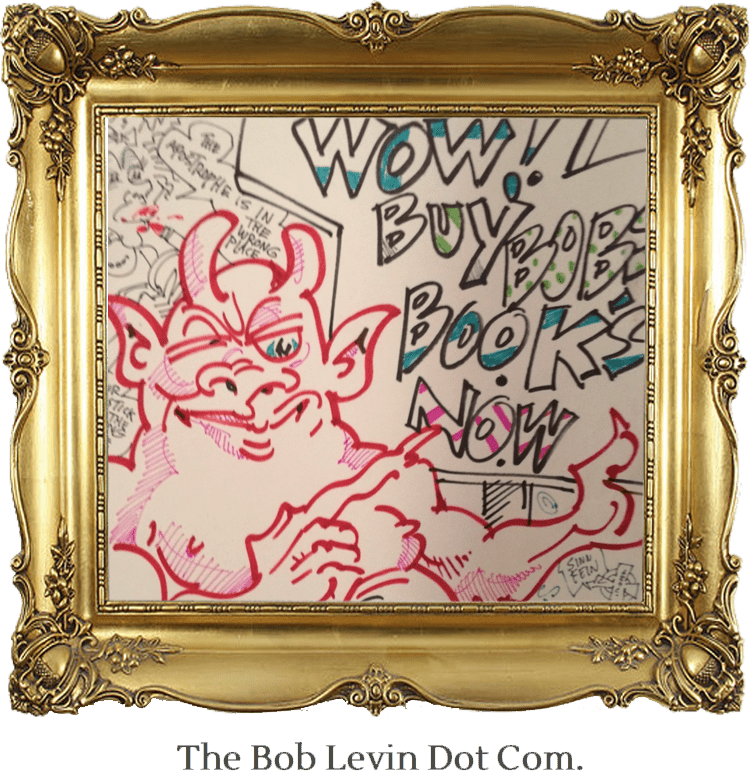
Gave a BEST DRESSED to a friend as a gift for his 85th birthday. (He hosted a private dinner at which an eight-course Sicilian dinner was served so my gesture may have struck some as being out of balance.) Sold a copy to a lawyer/novelist pal who wrote me, not remembering what happened to the cat, “My curiosity is piqued.” Swapped a copy for the forthcoming novel of a fellow I met when his wife came down from Benecia to read poetry at one of the soirees I used to host at the café.
In related news, a comic book store worker, who hopes to write a book about Vaughn Bode, came across my article (“the best and most well-researched bit of writing I’ve seen about (him)” e-mailed to arrange a chat with me. Coincidentally, just the week before, the fellow who’d been hoping to make a film about Vaughn expressed his desire to get together to bring me up to date on the “stops and (re)starts” that have occurred since I’d last heard from him a year or two ago. And CONVERSATIONS WITH TRINA ROBBINS, in which my interview of her is included, can now be pre-ordered from University Press of Mississippi. [Both the Bode and Robbins pieces are in MESSIAHS, MESHUGGANAHS…, which (I just checked) is available in 44 libraries, in case you don’t want to buy it.
In a less salubrious vein, the 35 copies of DRESSED I had sent to the incorrect address in Brooklyn are still sitting where they landed, waiting to be picked up by their intended recipient. Does anyone know someone in the area who does pick-ups and deliveries? I may be willing to intervene to speed up their entry into the stream of commerce.
blog
Adventures in Marketing — Week 551
Sold a BEST DRESSED to my former secretary and to a psychiatric social worker who frequents the café. Sold a MESSIAHS, MESHUGGANAHS… to a fellow who works for the Library of Congress. (We have never met but he has been a regular customer. In his email, out of the blue, he asked if I was a Phillies fan. I am waiting to find out why.)
Best reader reactions to BEST DRESSED of the week: (1) …a riot! Obsessive, absurdist, comical.”; (2) …a blast! The art is fantastic.”
In other news…
An independent French publisher, who does a series of The Art of… tributes to various
cartoonists, is planning one on Rory Hayes and stumbled across the article I wrote about Rory 20 years ago. (“Remarkably insightful and beautifully written,” the publisher says). He’s asked for permission to reprint it, which I was pleased (and honored) to give. That’s one of the neat and gratifying things about the Internet. If you post something about something that interests you, chances are it will interest someone else; and if they go looking for things written about this something, they may find what you wrote, and something may come of that.
The Hayes tribute is tentatively scheduled to appear late next year
The article originally appeared in THE COMICS JOURNAL #250, over 20 years ago, and was included in my OUTLAWS, REBELS… collection, which is out of print. You can find used copies on-line or order one, signed, directly from me for $20. POB 9492, Berkeley 94709.
ALL OF BOB’S BOOKS are available at www.theboblevin.com
Best reader reactions to BEST DRESSED of the week: (1) …a riot! Obsessive, absurdist, comical.”; (2) …a blast! The art is fantastic.”
In other news…
An independent French publisher, who does a series of The Art of… tributes to various
cartoonists, is planning one on Rory Hayes and stumbled across the article I wrote about Rory 20 years ago. (“Remarkably insightful and beautifully written,” the publisher says). He’s asked for permission to reprint it, which I was pleased (and honored) to give. That’s one of the neat and gratifying things about the Internet. If you post something about something that interests you, chances are it will interest someone else; and if they go looking for things written about this something, they may find what you wrote, and something may come of that.
The Hayes tribute is tentatively scheduled to appear late next year
The article originally appeared in THE COMICS JOURNAL #250, over 20 years ago, and was included in my OUTLAWS, REBELS… collection, which is out of print. You can find used copies on-line or order one, signed, directly from me for $20. POB 9492, Berkeley 94709.
ALL OF BOB’S BOOKS are available at www.theboblevin.com
Nos Qui Morituri
My latest piece is now up at www.tcj.com/rr-nos-qui-/
It begins:
At some point in the late 1980s or early ‘90s, when I was working to establish cred with The Comics Journal, I told an editor that I considered Watchmen the best novel of the last decade. Oops, I later thought. I should have said Love and Rockets.
Watchmen had been lauded at the time. It is taught, I see, in high schools today, which means it has been deemed no more troublesome than To Kill a Mockingbird. It does not excite Moms as do trans-sexuals and Toni Morrison. (Only in Missouri have school districts banned it.) Was it not the driven and demented work which had hooked me? It has fallen out of the conversations in my cafe – if it ever had been part of them. Perhaps the poorly received movie, which I didn’t see, or the highly lauded HBO series, which I’d been unable to watch, had overwhelmed the knife’s edge I had sensed sheathed between its covers. When I told a friend I was writing about the graphic novel, he was flabbergasted to learn it did not concern African-Americans. Its place in the pantheon might be worth a second look. While it was the only graphic work on Time magazine’s list of the greatest novels ever, the more elitist Journal ranked it only the 91st best English-language comic of the 20th century.
It begins:
At some point in the late 1980s or early ‘90s, when I was working to establish cred with The Comics Journal, I told an editor that I considered Watchmen the best novel of the last decade. Oops, I later thought. I should have said Love and Rockets.
Watchmen had been lauded at the time. It is taught, I see, in high schools today, which means it has been deemed no more troublesome than To Kill a Mockingbird. It does not excite Moms as do trans-sexuals and Toni Morrison. (Only in Missouri have school districts banned it.) Was it not the driven and demented work which had hooked me? It has fallen out of the conversations in my cafe – if it ever had been part of them. Perhaps the poorly received movie, which I didn’t see, or the highly lauded HBO series, which I’d been unable to watch, had overwhelmed the knife’s edge I had sensed sheathed between its covers. When I told a friend I was writing about the graphic novel, he was flabbergasted to learn it did not concern African-Americans. Its place in the pantheon might be worth a second look. While it was the only graphic work on Time magazine’s list of the greatest novels ever, the more elitist Journal ranked it only the 91st best English-language comic of the 20th century.
Adventures in Marketing — Weeks 549 – 550
Sold “Best Dressed”s to a pick-up basketball buddy and a newer café acquaintance.
Shipped 35 copies to Brooklyn, 10 for a distributor to sell on his own and 25 for shops that acquire stock from him. Sent a copy to a book/zine store SF to try to interest it in stocking it. (An insider tips me, it will probably put it up for sale, and I will only hear from it if it buys it, interesting them in more.)
Most quotable reaction: “Wonderful! I loved the text, the drawings, the entire “essay.” Highly original.” (This from a notable artist/critic/friend, though not one who has spared me his negative feelings about the cartoonists and the works I generally write about.)
In other news...
Do you know about Google Alerts? They let you know anytime something you are interested in is mentioned on the Internet. I generally put in my book titles, hoping to be tipped off to reviews. Well, the other day one arrived in Spanish, which seemed to say that “Messiahs, Meshugganahs...” had been nominated for something. Now my Spanish pretty much taps out after “Un doppio espresso, poquito,” so I asked my publisher, It told me I was up for a Ringo Award, which is bestowed by the Baltimore Comic Con. “It’s frankly unusual for the award to acknowledge such a legitimately great work, so this was a great surprise!”
I’m up for Best-Comic Related Publication. Only comic pros can vote, so if you know any, ask them to cast a allot for me – and American culture.

Otherwise, going forward, feel free to refer me to me as “The Ringo Award nominated…”
Adventures in Marketing — Week 548
Kicked off with a Pay Pal order from a young man I met a few weeks ago for a “Cheesesteak,” which he wanted to give as a birthday present to a friend from Philadelphia.
This was quickly overwhelmed by the arrival, hot off the Risograph, of “Best Dressed.”
(One copy – to a woman at the café – has been sold, and two people – another woman at the café and a distant FB-connected relative – have said they want one, but no money has as yet changed hands.) As for other reactions, copies given as gifts have produced the following: (1) a lengthy email denoting points of admiration and some for further discussion; (2) a text consisting entirely of hearts and exclamation points; (3) two “Thank you”s, one suggesting a shop in SF which might take some copies; (4) an apology from a fellow who had been too busy to read it but who admired the “eye-catching/popping zest” of Adele’s cover; and (5) a complaint from a cousin that she’d found herself “worn down” by the content. (This is the same cousin whose reaction to “Messiahs…” had been to wonder why I wrote about such “twisted” artists in the first place. She may not be my ideal reader.) Then, from the two-dozen people who received an e-mail announcement of the book’s issuance, I received one “Congratulations, Bob” and not another word.
But a fellow in Brooklyn with a distribution business for zines and indie comix wants three-dozen copies to try to move
Stay tuned.
This was quickly overwhelmed by the arrival, hot off the Risograph, of “Best Dressed.”
(One copy – to a woman at the café – has been sold, and two people – another woman at the café and a distant FB-connected relative – have said they want one, but no money has as yet changed hands.) As for other reactions, copies given as gifts have produced the following: (1) a lengthy email denoting points of admiration and some for further discussion; (2) a text consisting entirely of hearts and exclamation points; (3) two “Thank you”s, one suggesting a shop in SF which might take some copies; (4) an apology from a fellow who had been too busy to read it but who admired the “eye-catching/popping zest” of Adele’s cover; and (5) a complaint from a cousin that she’d found herself “worn down” by the content. (This is the same cousin whose reaction to “Messiahs…” had been to wonder why I wrote about such “twisted” artists in the first place. She may not be my ideal reader.) Then, from the two-dozen people who received an e-mail announcement of the book’s issuance, I received one “Congratulations, Bob” and not another word.
But a fellow in Brooklyn with a distribution business for zines and indie comix wants three-dozen copies to try to move
Stay tuned.
Adventures in Marketing – Week 547
No café action, but…
I received an e-mail from a woman in Pennsylvania with whom I had been in occasional correspondence with since she had stumbled upon “Outlaws, Rebels…” in a museum bookstore. She’s an artist (and fan of UG comix), and reading it, she felt, had changed her life. Now, having read “every single word in ‘Messiahs, Meshugganahs…,’” she wanted to tell me what an extraordinary book it was and what a significant writer I was, in language so laudatory I wouldn’t even direct my way in fantasy or day dreams.
She also wanted a signed copy of every book I’d written, even those she already had.
I received an e-mail from a woman in Pennsylvania with whom I had been in occasional correspondence with since she had stumbled upon “Outlaws, Rebels…” in a museum bookstore. She’s an artist (and fan of UG comix), and reading it, she felt, had changed her life. Now, having read “every single word in ‘Messiahs, Meshugganahs…,’” she wanted to tell me what an extraordinary book it was and what a significant writer I was, in language so laudatory I wouldn’t even direct my way in fantasy or day dreams.
She also wanted a signed copy of every book I’d written, even those she already had.
The Semi-Magnificent Bastards
My latest piece is up at https://www.firstofthemonth.org/the-semi-magnificent-bastards/. (That’s the July 17 issue. It begins: Once I heard the title Welcome to Painterland: Bruce Connor and the Rat Bastard Protective Association, (University of California Press. 2016), I hungered to lay my hands on a copy. Once I did, I wanted to throw it off the roof.
Adventures in Marketing: Weeks 536.5 — 546
Adventures in Marketing: Weeks 536.5 – 546

I had stopped selling my books at the cafe even before my hospitalization. When I got back, another fellow was selling books he’d written, and a third was selling an anthology he had poems in and a fourth was selling pocket knives and belt buckles and mini-stoves for camping.  (Actually, I haven’t seen any of them sell anything.) But even without trying I have been getting my product out there.
1.) An ex-newspaper reporter/ex-lawyer, who had been a year behind me in college, bought a “Bob on Bob.” He had recently seen Dylan in concert and was one of those who expected him to play what and sound as he did in 1965. Don’t people check out set lists? Don’t they listen to albums from the last 60 years. He didn’t; he was bummed; apparently he wanted to know what I thought of the changes time has wrought.
2.) Faithful readers will recall Glory, the schizophrenic with a manic depressive overlay, who had been born in Philadelphia but came to San Francisco as a child. Glory’s illnesses prevent her from reading books, but she had sent a copy of “Cheesesteak” to her 90-year-old mother, who has dementia. Her mother loved it, especially the chapter on Puddles (p.10), which she reads over and over. Glory decided to send copies to six cousins of hers, all of whom live in Philadelphia. I gave her a discount for buying in bulk.
3.) After I got out of the hospital, I felt an urge to contact people from my past I hadn’t been in touch with for a while. Partly it was about time and partly it was to see who was still here. One was Lester, the jazz pianist, who towards the end of “Cheesesteak” (p. 95), replies when asked if he is going to college, “What, man, you mean be an everybody?” (This line had enough resonance for it to be recalled to my by the 20-something-year-old son of a friend from NYC who was visiting Berkeley the week before.) Anyway, Lester is fine, had, in fact, just played a gig with his trio at a restaurant on Chestnut Street and was so delighted at being quoted 60-years down the road, he asked for another copy, which I was delighted to send him.
ALL OF BOB’S BOOKS ARE AVAILABLE AT WWW.THEBOBLEVIN.COM
Last 10 Books Read XXXV
(In order of completion)
Introduction
Since my last entry, I underwent an operation which sent me into cardiac arrest, threw me into a two- or three- day coma, and left me hospitalized for weeks. I have been home two-and-a-half and am recovering.
While I was in the hospital, I asked a friend to bring me a novel from home which I thought I had been reading. He brought it, but said it had been shelved with books I seemed to have finished. I had forgotten that and, as you will see, other things as well.
1. George Saunders. “A Swan in the Pond in the Rain.” I recall enjoying the first two-thirds to three-quarters. It’s drawn from classes Saunders taught which, by focusing on short stories of Chekhov, illuminated how writers write and readers read and the relationships between the two.
2. Thomas Bernhardt. “Extinction.” I’ve read a number of Berhardt’s novels (See previous “Last Ten”s). In some ways they are indistinguishable, and while I can recall no specifics of this one, am sure I found it worthy.
3. Virginie Despante. “Vernon Subutex.” The first volume of a trilogy about dissolute, aging members of a post-punk Parisian bohemian scene.
4. Virginie Despante. “Vernon Subutex” (vol. 2). The story continues. Before I had finished, I realized these people’s lives and concerns were so different than mine, they might have belonged to a different galaxy. At which point, I tossed volume 3.
5. Kevin Burroughs. “The Most Dangerous Book.” An informative, entertaining account of James Joyce’s “Ulysses,” including its struggles to pass through little magazines, into little publishing houses, and, finally, against legal opposition, the mainstream. Many fascinating people are encountered and many odd facts unearthed.
6. Eleanor Caton. “Luminaries.” The author, a young New Zealand woman as I recall, won the Booker Prize for this sprawling, often confusing, Victorian-novel like yarn. Gold, murder, sex – and muddled relationships are involved. Reasonably entertaining; challenging not so much.
7. Carol Tyler. “Ephemerata.” Tyler, a fine graphic novelist, addresses the loss of her parents, her husband, and, maybe, a sybling, and/or pet (I forget). It is well done – but it is like like immersing yourself in a couple hundred page bath of misery.
8. Henry Green. “Surviving Stories, Essays, Interviews.” I have valued several of Green’s novels. This stuff could have been left in his desk drawer as far as I am concerned though.
9. Florian Iler. “1913.” I remember nothing about this. Nothing about the author. Nothing about the book. (A novel). I think it was good though.
10. Thomas Bernhardt. “The Voice Imitator.” This is the book I had forgotten I had read. It was Bernhardt’s last, a collection of page or less “stories,” consistent with the voice and attitude of his novels, but a coda to them. Cocky and grim riffs on the frailties of man.
Afterword
On this memory thing, (1) yesterday I learned I’d had a phone conversation shortly before I went into the hospital with a cartoonist pal in Kentucky, which I had completely forgotten; and (2) Adele and I settled in to watch “Marty Supreme,” which seemed to have just been made available for free on TV. As soon as it started, I realized I had seen it before. (This held true the entire first half.) So it must have been there for several weeks. Again I had forgotten I had seen any of it.
But I can still tell you the starting line-up for the 1950 Phillies.
Adventures in Marketing: Weeks 532 – 536.5
Sold a BEST Ride (via web site). The buyer was in LA. Aha! I thought. Movie option money. The time seemed right. NBA gamble-tainting and all.
But no. He was a writer of books about the Olympics and Para-Olympics and a friend (he didn’t recall who) had recommended my book. He was from New York and the glory days of the 1970s Knicks and Dr. J-led Nets. He liked the book. “A story well told.”
The next day, an e-mail with the “Subject” “Jimmy Don Polk” arrived. Aha! I thought, beginning to suspect I was not the pure artist I liked to pass myself off as, someone wants to make a movie out of FULLY ARMED.
But no. The e-mail was a college psychology professor, whose class Jimmy had taken. She had lost touch with him and feared the worst had happened. I told her what I knew, which was the worst had happened, but in far from any of the worst ways it might have. Jimmy went in peace and, in many ways, fulfilled.
In other news…
1.) I may have mentioned the chapbook/mini-comic I and a café pal have collaborated on. (Text by me; illustrations by him; cover by Adele. He showed me a dummy copy yesterday, and, with tweaks, it will be ready to go soon.
2.) An amusing story for those of you who have stuck around this far. A Danish fellow, who is writing/compiling an homage to/celebration of Vaughn Bode, with whom I opened MESSIAHS, MESHUGGANAHS, asked if I would look over his m.s. (A request quickly withdrawn after he found additional material to include.) Before he called me off, I got as far as where I was described as a jazz critic, as well as a writer about UG cartoonists. I had to tell him I was not a jazz critic. That was a different Bob Levin.
I first heard of that Bob Levin when I was looking for an agent to help me negotiate my contract for, circling back to where we began, BEST RIDE. The woman who took me on was/had been the agent for the jazz critic Bob Levin. That had worked out well enough she decided to try her luck at a second.
Wherever you go, there you are.